How Food Truck Logos Differ from Restaurant Logos: A Strategic Breakdown

In the competitive world of food service, branding can mean the difference between a long line around the block and a business that never gets off the ground. But not all food branding is created equal. A sit‑down restaurant and a mobile food truck operate in completely different visual and physical environments. As a result, their logos must solve different problems. At the heart of this distinction is the food truck logo —a design asset that follows very different rules than its restaurant counterpart.
Understanding these differences isn’t just an academic exercise. For entrepreneurs, getting the logo wrong can cost thousands in missed sales. For designers, knowing when to build for a building versus a vehicle is essential. Let’s break down exactly how these two branding worlds diverge.
1. Context of Viewing: Motion vs. Destination
The most fundamental difference is where and how the customer sees the logo.
- Restaurant Logo: Lives on a stationary building, menus, takeout bags, and matchbooks. Customers usually see it while walking slowly, sitting in a car, or browsing online. They have time to absorb detail.
- Food Truck Logo: Lives on a moving vehicle that parks in crowded events, street corners, and festival grounds. Potential customers often spot the truck from 50 feet away while walking past quickly or stuck in traffic.
A food truck logo must be readable from a distance, in motion, and often in poor lighting. A restaurant logo can afford intricate illustrations and thin serif fonts because the viewer is stationary. A food truck cannot. If a customer cannot read the truck’s name or understand what is being sold in under three seconds, the truck has already lost a sale.
2. Physical Constraints: Wrap Space vs. Storefront
Restaurants enjoy predictable, rectangular real estate. A storefront sign is typically horizontal, protected from the elements, and backlit at night. The logo sits comfortably within those dimensions.
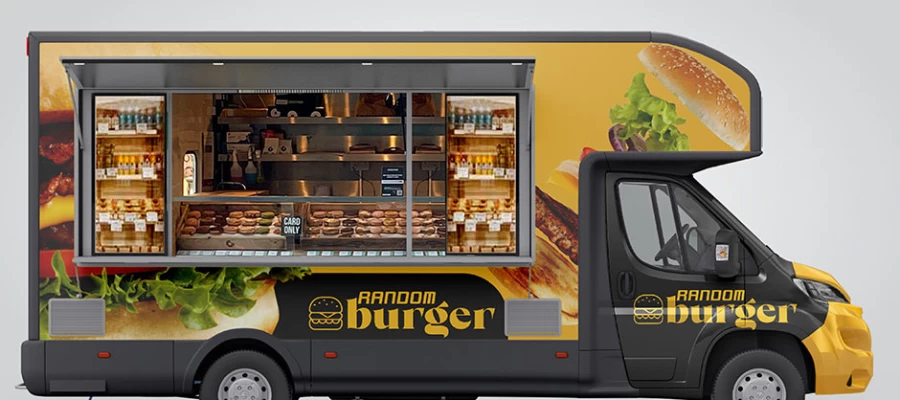
A food truck, however, is an irregular canvas. The logo must work around wheel wells, serving windows, exhaust pipes, and generator compartments. The food truck logo often becomes part of a full vehicle wrap, meaning it needs to stretch, bend, or repeat across curved metal surfaces.
Furthermore, food trucks cannot rely on interior signage. There is no host stand, no lobby, and no table tent. The logo on the exterior of the truck is often the only brand communication. That means the logo must also communicate the cuisine type. For example:
- A taco truck logo might include a subtle chili pepper or cactus silhouette.
- A burger truck logo might use bold, chunky lettering that suggests “fast and filling.”
Restaurant logos can be abstract because the menu is inside. Food truck logos must be self‑explanatory from the curb.
3. Color Psychology and Practicality
Restaurants have controlled lighting. A fine dining establishment can use a navy blue and gold logo on a dark wood storefront. It looks elegant under dim, warm bulbs.
Food trucks operate under harsh sunlight, gray rainy skies, and sometimes only the glow of a streetlamp. A food truck logo requires high contrast and often uses a limited color palette for durability and visibility.
- High visibility colors: Bright yellows, reds, oranges, and lime greens dominate food truck branding because they pop against asphalt and concrete.
- Durable printing: Vehicle wraps fade in UV light. Food truck logos avoid subtle gradients or pastels that will look washed out after three months on the road.
- Nighttime readability: Many food trucks serve late nights outside bars. A reflective or glow‑friendly logo design is a smart business decision.
Restaurants can change their lighting seasonally. Food trucks cannot. The logo must perform at noon and midnight without adjustment.
4. Longevity and Rebranding Costs
A restaurant typically rebrands every 7 to 10 years. A new logo means new menus, new signage, and maybe new uniforms—costly but manageable.
A food truck rebrand is significantly more expensive because the food truck logo is physically printed on a vehicle wrap. Removing a wrap and reinstalling a new design can cost $3,000 to $6,000 or more. Therefore, food truck logos must be designed for longevity. Trends like ultra‑flat line art or distressed vintage fonts might look cool for one season but will feel dated by year three.
Restaurants can experiment with seasonal logos on coasters or social media. Food trucks commit their logo to a mobile billboard that drives across the city every day. That permanence demands timelessness.
5. Legal and Operational Differences
Surprisingly, trademark law treats food trucks and restaurants similarly, but operational realities differ.
- Restaurant logos are often trademarked for a specific geographic address and service style (e.g., “sit‑down Italian”).
- Food truck logos must consider mobility. A truck that parks in three different counties may need broader trademark protection. Additionally, a food truck logo must not resemble any existing truck in a 50‑mile radius because two trucks with similar logos at the same festival cause massive customer confusion.
Also, health department regulations sometimes restrict where a logo can be placed on a truck (e.g., not too close to the serving window where it could trap grease). Restaurant logos rarely face such physical constraints.
6. Scalability Across Merchandise
Both restaurants and food trucks sell merchandise, but the priorities differ.
- Restaurants sell t‑shirts, hats, and mugs as secondary revenue. The logo is usually centered on the chest.
- Food trucks rely heavily on merchandise as mobile advertising. A customer wearing a food truck logo t‑shirt becomes a walking billboard. Therefore, food truck logos need to look excellent embroidered on a hat, screen‑printed on a hoodie, and stamped on a koozie—all while remaining legible at small sizes.
Many food truck logos use a bold, chunky wordmark or a mascot head (e.g., a cartoon lobster or taco) because these shrink well and read easily on apparel. Restaurant logos often include taglines, founding dates, or location details that become illegible on a pinback button.
7. Emotional Connection: Urgency vs. Ambiance
Finally, consider the customer’s emotional state.
- A restaurant diner is relaxed, seated, and ready to browse a menu. The logo can be subtle, sophisticated, and reward close inspection.
- A food truck customer is usually hungry, in a hurry, and standing in the sun or cold. The food truck logo must create immediate appetite appeal. Rounded, friendly fonts suggest approachable comfort food. Sharp, angular fonts suggest bold flavors or spicy cuisine.
A restaurant logo can afford to be mysterious (“what is this place?”). A food truck logo cannot. If it doesn’t make you hungry in two seconds, the customer walks to the next truck.
Summary Comparison Table
| Feature | Restaurant Logo | Food Truck Logo |
| Viewing context | Stationary, close up | Moving, from a distance |
| Color needs | Controlled lighting | High contrast, UV durable |
| Complexity | Can be detailed | Must be simple and bold |
| Rebrand cost | Moderate | High (full vehicle wrap) |
| Scalability | Secondary concern | Critical for merchandise |
| Emotional goal | Ambiance and trust | Urgency and appetite |
Final Takeaway
A beautiful restaurant logo will fail on a food truck. Conversely, a loud, high‑contrast food truck logo might look out of place on a fine dining storefront. The difference is not about quality—it is about context. Food trucks are moving billboards in chaotic environments. Their logos must be fast, durable, and unmistakable from 50 feet away. Restaurants can afford nuance.
If you are launching a mobile food business, invest in a designer who understands vinyl wraps, sunlight fade tests, and three‑second readability. Your logo is not just an identity. It is your first, last, and only chance to stop a hungry pedestrian mid‑stride.