Over Easy Eggs Guide: The Flip, the Yolk and the Truth

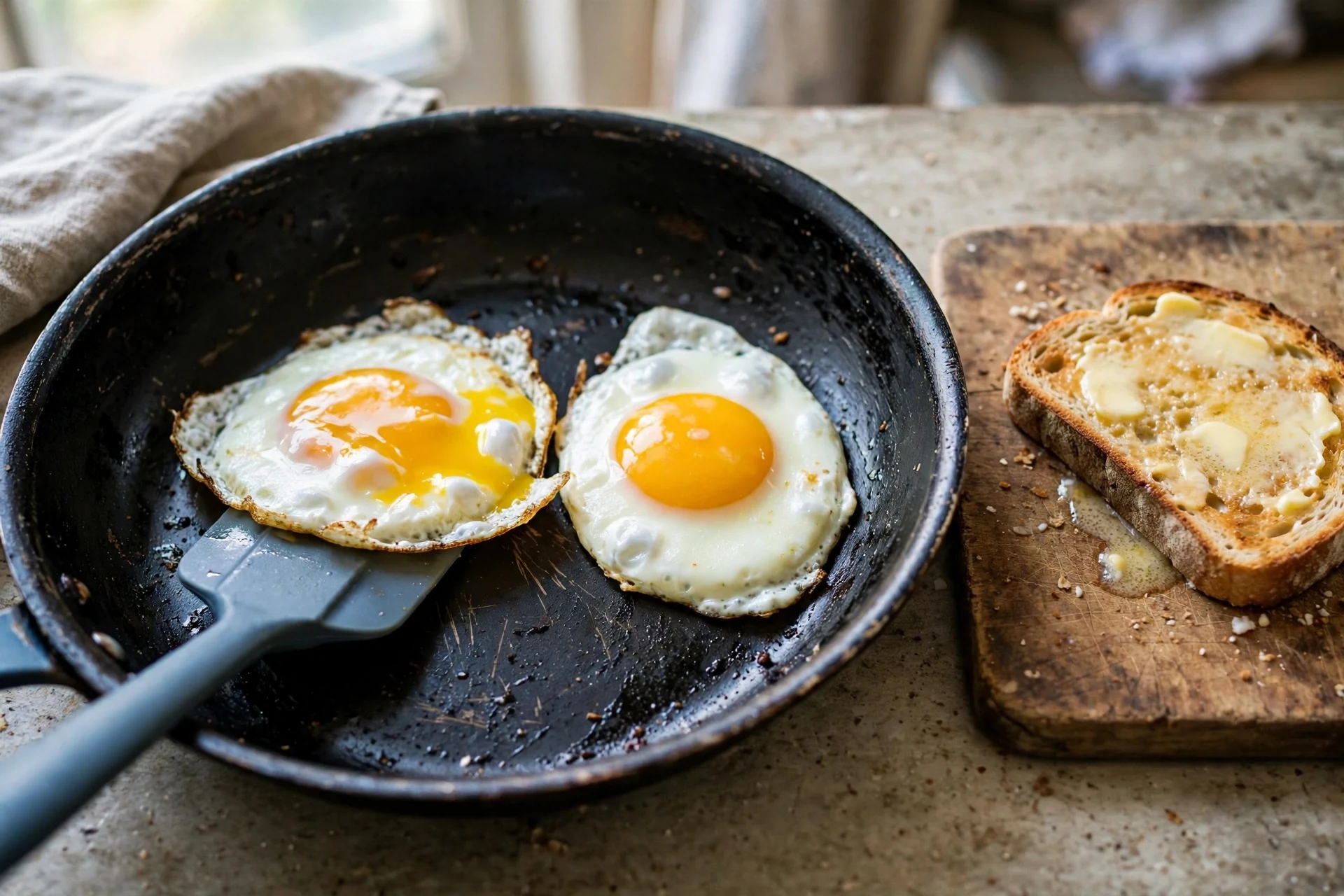
One flip, thirty seconds, and a yolk that stays runny — if you know when to turn it.
There is a moment in every diner breakfast when the cook does the one thing that separates an over easy egg from every other fried egg, and it takes about two seconds. The spatula slides under the egg, the wrist turns, and the egg lands yolk-side down for half a minute. Done right, you get set whites and a yolk that runs the moment your fork touches it. Done wrong, you get a broken yolk, a pan full of yellow, and a breakfast that tastes fine but looks like an accident.
This article is about that moment, and about the numbers around it — because the numbers are where the recipes disagree, and they disagree a lot. Six competitors were read in full for this article, and their second-side times run from ten seconds to a full minute, a six-fold spread. Their first-side times run from a minute and a half to three minutes. Their butter runs from a teaspoon per egg to a tablespoon per egg. None of them admits the spread exists. This article stages every one of those disagreements with the source’s name beside it, so you can see who says what and choose for yourself.
The other thing no recipe page in this research does is tell you the safety line plainly. A true over easy egg, runny yolk by definition, does not reach the USDA’s 160 degree standard for egg dishes, and does not have a firm yolk. That matters for some readers more than the flip does, and this article puts it in its own section instead of hiding it in a footnote.
Quick Answer: Over easy eggs are fried eggs flipped once, cooked briefly on the second side, with the whites set and the yolk completely runny. The flip is the whole difference: sunny side up is never flipped, over medium is flipped and cooked longer until the yolk turns jammy, and over hard is flipped and cooked until the yolk is fully set. For two eggs, melt 1 tablespoon of butter in an 8-inch nonstick skillet over medium heat, cook undisturbed about 2 minutes until the whites are opaque except for about a half-inch of unset white around the yolks, flip once, cook 30 seconds more, and serve immediately. The times disagree across sources — first side 1 and 1/2 to 3 minutes, second side 10 seconds to 1 minute — so this article gives you a visual signal (the half-inch rule) and a poke test instead of a clock alone. One honest warning first: a runny yolk does not meet the USDA’s 160 degree egg-dish standard, so pregnant women, young children, older adults and people with weakened immune systems should not eat one — pasteurized eggs, or a yolk cooked until firm, are the safe alternatives.
The Word Check
Start with the word, because this time the word is real — and the word tells you exactly what to do. “Over easy” has a dictionary entry, verified directly for this research. Wiktionary defines it, marked as American usage, as an egg “fried on one side until most of the whites have cooked, then lightly fried on the other to finish cooking the whites, leaving the yolk unbroken and slightly soft (runny).” So this article does not claim “no dictionary entry” — the entry exists, and it is the first finding, not a footnote.
Read the definition slowly, because it contains the whole method in one sentence. “Over” means the flip. “Easy” means the yolk is still runny. The egg is fried on one side until most of the whites have cooked, then lightly fried on the other to finish the whites, and the yolk stays unbroken and slightly soft. Every word in that sentence is a cooking instruction: fry, flip, lightly, unbroken, runny.
The family around it runs from least cooked to most cooked, and the names work the same way — “over” always means flipped, and the word after it names the yolk:
- Sunny side up — cooked on one side only, never flipped. The whites are just set, the yolk is raw. No flip at all, so by the dictionary definition it is not an “over” egg in any sense.
- Over easy — flipped once, cooked briefly on the second side. The whites are set, the yolk is completely runny. MasterClass calls it “the second to lowest rung (after sunny side up)” in the doneness ladder.
- Over medium — flipped once, cooked longer on the second side. The whites are firm and the yolk is like a loose custard, jammy, the way a soft-boiled egg yolk is.
- Over hard — flipped once, cooked until the yolk is fully set, flaky and crumbly, like the centre of a hard-boiled egg. In diner usage this is also called “over well.”
The confusion the article has to clear up is the one readers actually have, and it is two confusions, not one. The first is over easy against sunny side up: the same plate, the same runny yolk, and the only difference is the flip — one gets turned, the other never does. The second is over easy against over medium: the same flip, and the only difference is the second-side time — about 30 seconds against a minute or more. The flip is the difference in the first case, and the clock is the difference in the second.
The honest frame for the whole article follows from that. Over easy eggs are a real, defined American diner term with a dictionary entry, and the article’s job is not debunking a fake word. It is the numbers competitors never agree on — the first-side time, the second-side time, the butter amount and the heat — plus the safety line no recipe page states plainly, and plus the one step every competitor agrees is the hard part: the flip itself.
Over Easy vs Sunny Side Up vs Over Medium
The comparison readers need first is the one between the three eggs that look almost identical on the plate, because the differences are small and the names get swapped in conversation. The table below compares them on the four things that actually differ: whether the egg is flipped, what the white looks like, what the yolk looks like, and how long the second side takes.
Table 1: The Four Fried Eggs
| Style | Flipped? | White | Yolk | Second side |
|---|---|---|---|---|
| Sunny side up | No, never flipped | Just set, barely firm, edges can crisp | Raw | None — no second side |
| Over easy | Yes, flipped once | Set | Completely runny | 10 seconds to 1 minute, by source |
| Over medium | Yes, flipped once | Firm | Loose custard, jammy | 30 seconds to 3 minutes, by source |
| Over hard | Yes, flipped once | Firm | Fully set, flaky and crumbly | 1 and 1/2 to 5 minutes, by source |
Read the table slowly, because the second-side column is the point of the whole article. The yolk column tells you what each style is. The second-side column tells you how little the sources agree on getting there. Over easy runs from 10 seconds to a minute. Over medium runs from 30 seconds to 3 minutes. Over hard runs from a minute and a half to 5 minutes. Those are not rounding differences — they are different eggs, and the article stages each source’s time with its name in the tables below rather than blending them into one number.
Two smaller points belong with the table. First, the whites-versus-yolks temperature gap is why the flip exists at all. Egg whites become all the way cooked at 180 degrees Fahrenheit, while egg yolks are “cooked” at 158 degrees, according to America’s Test Kitchen as summarised by DVO — a figure this research did not read on ATK’s own page, so it is attributed that way and not presented as a direct read. That 22-degree gap is why the white can turn rubbery before the yolk is done, and why the flip — or the steam in ATK’s no-flip method — exists: something has to finish the top of the white without overcooking the yolk. Second, the “over well” name for a fully set yolk appears in diner usage, in one secondary summary, but not in the Wiktionary entry read for this research — so this article mentions it only as diner usage and does not present it as a dictionary term.
The Numbers
No competitor in this research publishes a single USDA figure for an egg, and the table below is the first one in the whole keyword with a measurement behind it for every row. Every figure comes from USDA FoodData Central, with the record IDs kept so a reader can check them.
Table 2: One Egg, Two Eggs and the Butter — USDA FoodData Central
| Food | Amount | Calories | Protein | Fat | Cholesterol | Sodium |
|---|---|---|---|---|---|---|
| Egg, whole, raw, fresh (FDC 171287), per 100 g | 100 g | 143 kcal | 12.6 g | 9.5 g | 372 mg | 142 mg |
| One large egg (50 g) | 1 egg | About 72 kcal | 6.3 g | 4.8 g | 186 mg | 71 mg |
| Two large eggs (100 g) | 2 eggs | 143 kcal | 12.6 g | 9.5 g | 372 mg | 142 mg |
| Butter, salted (FDC 173410), per 100 g | 100 g | 717 kcal | 0.85 g | 81.1 g | 219 mg | 643 mg |
| One tablespoon butter (14.2 g) | 1 tablespoon | 102 kcal | 0.1 g | 11.5 g | 31 mg | 91 mg |
The full raw-egg picture, for the record, is this: per 100 grams, a whole raw fresh egg carries 143 kilocalories, 12.6 grams of protein, 9.5 grams of total fat, 3.1 grams of saturated fat, 0.7 grams of carbohydrate, 0.4 grams of sugars, no fiber, 372 milligrams of cholesterol, 142 milligrams of sodium, 138 milligrams of potassium, 56 milligrams of calcium, 1.75 milligrams of iron, 160 micrograms of vitamin A RAE, 2.0 micrograms of vitamin D, and 294 milligrams of choline. Those are the figures behind every number in this article, and they are all USDA FoodData Central, record FDC 171287.
The headline in the table is the protein and the choline: 12.6 grams of protein and 294 milligrams of choline per 100 grams for 143 kilocalories. The egg itself is the nutrition story. The butter is where the calories climb — and the table makes that plain too. One tablespoon of butter, 102 kilocalories, carries more calories than one large egg at about 72 kilocalories. The fat, not the egg, is what makes the plate heavier, and the featured recipe says so in its own arithmetic.
One conflicting secondary figure belongs here, staged honestly rather than hidden. An older secondary record lists 147 kilocalories and 423 milligrams of cholesterol per 100 grams of egg. The consistent FDC 171287 figures across the other sources are 143 kilocalories and 372 milligrams of cholesterol, and a second FDC record for raw whole egg shows 143 kilocalories but 411 milligrams of cholesterol and 12.4 grams of protein — a different record, not the same egg. This article uses FDC 171287 throughout and does not blend the records, and it does not use the 147 and 423 figures.
The butter figure carries its own small note. US brand labels commonly print 100 kilocalories per tablespoon of butter. That is label rounding against USDA’s analytical 717 kilocalories per 100 grams, not a different butter. This article uses USDA’s 102 kilocalories per tablespoon, because the arithmetic in the featured recipe is built on USDA figures, and mixing a label figure into a USDA table would make the total wrong by a little and the method wrong by a lot.
The Times Disagree
Here is the disagreement no competitor acknowledges, and it is the biggest one in the research. Every source gives times. No two sources give the same times. And the spread is not small — it is six-fold on the second side, which is the side that decides whether the yolk stays runny.
First side first. The table below gives every source’s first-side time with its name. The range is a minute and a half to three minutes.
Table 3: First-Side Times, by Source
| Source | First side | Signal given |
|---|---|---|
| Allrecipes (user-submitted recipe) | 1 and 1/2 to 2 minutes | White firm and set, yolk still runny and intact |
| Little Spoon Farm (excerpt only) | 1 to 2 minutes | White almost fully set |
| The Kitchn | About 2 minutes | Whites almost completely set and opaque except for the half-inch area around the yolks |
| Currence, via James Beard Foundation | About 2 minutes | Whites cooked almost through, still slightly clear and runny on top |
| Taste of Home | 2 to 3 minutes | Whites set |
| MasterClass | About 3 minutes | Whites just beginning to firm up |
| Australian Eggs | 3 minutes | No signal given, time only |
| Foodbank (excerpt only) | 3 minutes | White cooked through |
The first-side range is 1 and 1/2 to 3 minutes, and the signal column matters more than the clock column. The Kitchn gives the clearest signal in the research: cook undisturbed until the whites are almost completely set and opaque except for about a half-inch of unset white around the yolks. Currence gives the second clearest: the whites are cooked almost through but still slightly clear and runny on top. MasterClass gives the vaguest: the whites are “just beginning to firm up.” The article’s own recipe uses 2 minutes with the half-inch rule as the signal, not the clock — because a clock cannot see your pan, your heat, or your egg, and the half-inch of unset white can.
Now the second side, where the disagreement gets serious.
Table 4: Second-Side Times for Over Easy, by Source
| Source | Second side |
|---|---|
| Currence, via James Beard Foundation | 10 to 15 seconds |
| Allrecipes (user-submitted recipe) | 15 to 20 seconds |
| MasterClass | 30 seconds, then flip back yolk-side up |
| The Kitchn | About 30 seconds |
| Australian Eggs | 30 seconds |
| Little Spoon Farm (excerpt only) | 30 seconds to 1 minute |
| Taste of Home | 30 to 60 seconds |
| spice.alibaba.com (excerpt only, content farm) | 30 to 60 seconds in one article, 20 to 30 seconds in another |
| Foodbank (excerpt only) | 1 minute |
The range is 10 seconds to 1 minute — a six-fold spread — and the table stages all of them because no single number in it is the consensus. Ten seconds (Currence) and a full minute (Foodbank) are not the same egg. A minute on the second side is long enough to start setting the yolk, and ten seconds is barely long enough to seal the white. The article’s own recipe picks 30 seconds, from the middle of the staged range, and states it as the article’s choice, not a consensus. MasterClass’s entry carries its own warning: its 30 seconds is followed by a second flip back to yolk-side up, a double flip no other competitor does, and the article’s own recipe flips once.
The over medium and over hard times disagree just as widely, and the article stages those too, because a reader who wants to go one rung up the ladder deserves to know the sources do not agree there either.
Table 5: Over Medium and Over Hard Second-Side Times, by Source
| Source | Over medium, second side | Over hard, second side |
|---|---|---|
| Currence, via James Beard Foundation | 30 seconds, then flip back | 1 and 1/2 minutes, then flip back and cook 30 seconds more |
| Taste of Home | 1 minute | 2 to 3 minutes |
| Foodbank (excerpt only) | 2 to 3 minutes | 4 to 5 minutes |
| MasterClass | No time given — yolk “like a loose custard” | No time given — yolk “fully cooked through” |
The over medium range alone is 30 seconds to 3 minutes. The over hard range is a minute and a half to 5 minutes. If you follow Currence you get a jammy yolk in half a minute; if you follow Foodbank you are still waiting three minutes in. The article does not resolve this. It prints the table and lets the reader see the spread, because pretending the sources agree would be the one thing worse than the disagreement itself.
The Fat Disagreement
The fat is the second disagreement, and it is the one that decides how many calories land on the plate — because, as the numbers table showed, a tablespoon of butter carries more calories than a whole egg. The sources range from a teaspoon of fat per egg to a tablespoon per egg, a three-fold spread.
Table 6: Fat per Egg, by Source
| Source | Fat amount | Fat used |
|---|---|---|
| spice.alibaba.com (excerpt only, content farm) | 1 teaspoon per egg | Butter or oil |
| Taste of Home | 1 tablespoon for 4 eggs | Butter |
| Allrecipes (user-submitted recipe) | 1/2 tablespoon per egg | Unsalted butter |
| The Kitchn | 1 tablespoon for 2 eggs | Unsalted butter |
| Australian Eggs | 1 tablespoon for 2 eggs | Olive oil |
| MasterClass | 1 tablespoon per egg | Butter, ghee, or oil of choice |
| Currence, via James Beard Foundation | 2 tablespoons for 2 eggs | Clarified butter |
| America’s Test Kitchen (no-flip method) | 2 teaspoons vegetable oil plus 2 teaspoons butter for 4 eggs | Two fats — oil, then butter |
Read the table and the calorie arithmetic together. At Taste of Home’s amount, one tablespoon of butter for four eggs, the butter adds about 26 kilocalories per egg. At MasterClass’s amount, one tablespoon per egg, the butter adds 102 kilocalories per egg — more than the egg itself. At Currence’s amount, two tablespoons of clarified butter for two eggs, the fat adds 102 kilocalories per egg as well, and clarified butter is a chef’s choice that most home cooks do not have in the fridge. The article’s own recipe uses The Kitchn’s amount — 1 tablespoon for 2 eggs, about 51 kilocalories of butter per egg — and says so, because it is the middle of the staged range and it films an 8-inch pan without drowning the eggs.
Butter or oil is the other half of the argument, and the sources split on flavour, not on safety. The Kitchn says oil fries an egg perfectly well, but butter adds a nutty flavour and richness. Taste of Home agrees — oil is perfectly acceptable, but butter is more delicious, and leftover bacon grease can fry eggs too. Australian Eggs is the only competitor to lead with oil: it recommends olive oil, and says butter can be substituted for a richer flavour depending on the dish — oil for an Asian-inspired noodle dish, butter for a fried egg sandwich with avocado and cheese. One warning in Taste of Home needs staging as what it is: it says to avoid canola oil because it “won’t impart any flavor to the eggs.” That is a flavour preference, not a safety or quality finding, and this article does not present it as a rule.
America’s Test Kitchen uses two fats, and the reason is worth stating because it is the only source to give one. Vegetable oil goes in first for its high smoke point, and the butter is added just before the eggs for richness. The oil takes the heat; the butter brings the flavour. It is a small piece of method, and it is the kind of detail that separates a tested recipe from a rewritten one.
The heat setting splits the same way the times do. Five sources cook on medium: MasterClass, The Kitchn, Taste of Home, Allrecipes, and Australian Eggs — which adds that if the oil starts to spit, turn the heat down to low. Currence is the only competitor to cook on low. Little Spoon Farm, at excerpt level, cooks on medium-low, “typically around 2.5-3 on a scale of 1 to 10.” The content-farm excerpts say medium-low too, and give two different temperature ranges in two different articles — “275-300 degrees Fahrenheit” in one, “300-325 degrees” in another — which is the content farm contradicting itself, and this article does not use either figure as a verified temperature. ATK is the two-step exception: low heat for a full 5 minutes to preheat, then medium-high briefly until the oil shimmers. The article’s own recipe cooks on medium, with the five-source majority, and says so.
The Flip
Everything in this article leads to the flip, because the flip is the step every competitor agrees is the hard part — and no two of them describe it the same way.
The readiness signal comes first, and The Kitchn gives the clearest one in the research: wait until almost all the whites are cooked and set, going from clear to opaque, until there is just about a half-inch of unset white surrounding the yolks. Cook the eggs undisturbed until then. That half-inch ring is the signal the article’s own recipe uses, and it is the signal the 30-Second Flip Test in the featured recipe is built on.
The spatula matters, and the sources disagree about it in a useful way. The Kitchn says to use a wide, flat spatula, and to use its edge to cut and separate the eggs first if the whites have run into each other, so that you are only flipping one egg at a time. Taste of Home says to use a silicone spatula rather than a metal one, because metal spatulas are sharper and can make the yolk break easily when scooped underneath. Currence does not lean on the spatula at all — he agitates the pan gently in a circular motion as the whites set, so the eggs loosen before the spatula ever goes under them. Allrecipes and Australian Eggs say only to flip gently. The article’s own recipe takes The Kitchn’s wide, flat spatula and Taste of Home’s silicone preference together: a wide, flat, silicone spatula, centred under the yolk, because a sharp metal edge under a runny yolk is the most common way the yolk breaks.
The technique itself, staged across the sources:
- The Kitchn: slide the spatula under the first egg, make sure it is centred under the yolk, take a deep breath, and gently flip the egg over.
- MasterClass: gently slide a spatula under the fried side of the egg and lift from the pan’s surface, then tip the spatula slowly — but also swiftly, and do not hesitate — until the uncooked corner touches the pan, then lay the egg yolk-side down.
- Taste of Home: slide the spatula fully underneath one egg and flip, repeat for the rest; stay as close to the pan as possible and turn the wrist slowly.
- Currence: agitate the pan gently in a circular motion as the whites set, then flip when the whites are cooked almost through.
- Allrecipes and Australian Eggs: flip gently, being careful not to break the yolk.
The article’s own flip, step by step, is a single method, not a blend: slide the wide, flat spatula under one egg, centred under the yolk, with the spatula flat against the pan. Lift just enough to clear the pan’s edge. Turn the wrist in one smooth motion, staying close to the pan, and lay the egg yolk-side down where it lands. Do not lift high, do not hesitate halfway, and do not flip twice — once the seal forms, the egg is flipped, and the second side needs 30 seconds, not a second flip.
Two details from the sources belong here because they are the kind of thing a reader remembers. First, the pepper: The Kitchn is the only competitor to time it, and the reason is a good one — season with salt before cooking, and wait until after the flip to add pepper, because pepper added before the flip burns and loses its potency. Taste of Home seasons with salt and pepper immediately, MasterClass seasons after cooking, Currence seasons as the whites set, Australian Eggs seasons to taste after serving, and Allrecipes seasons after transferring to the plate. Five different moments, staged here; the article’s own recipe follows The Kitchn, salts before and peppers after, and says why. Second, the freshness check: Taste of Home gives the float test — fill a cup of water, drop in an egg, and if it lies horizontally it is fresh, while if it floats it is past its prime. Australian Eggs gives the reason behind it: fresh eggs have stronger whites that protect the yolk when you flip, and older eggs spread more and are better for boiling. The caveat no competitor gives is this: the float test measures the size of the air cell, which grows as the egg ages. A floating egg is old, not necessarily unsafe, and a sinking egg is not a guarantee of freshness. The article carries that caveat, because a test that measures age should not be read as a test of safety.
Featured Recipe: Over Easy Eggs
This is the article’s own recipe, written for this article, with the egg and butter nutrition computed from USDA FoodData Central figures (egg, whole, raw, fresh, FDC 171287: 143 kcal, 12.6 g protein, 9.5 g fat, 372 mg cholesterol per 100 g; butter, salted, FDC 173410: 717 kcal per 100 g, 102 kcal per tablespoon). It is not taken from a source, and it is not described as tested by a third party. The times are the article’s own choice from the staged range, stated as such — not a consensus.
Serves 1.
You need: 2 large eggs; 1 tablespoon unsalted butter; kosher salt; freshly ground black pepper.
Equipment: an 8-inch nonstick skillet; a wide, flat spatula, silicone preferred; a small bowl for cracking the eggs.
The method: melt 1 tablespoon of unsalted butter in the 8-inch nonstick skillet over medium heat and tilt the pan so the butter films the bottom. Crack 2 large eggs into the small bowl first, to check for shell, then slide them gently into the pan. Season with kosher salt. Cook undisturbed for about 2 minutes, until the whites are almost completely set and opaque except for about a half-inch of unset white around the yolks. Give the pan a gentle shake: if the yolk wobbles but the white stays put, it is ready to flip. Slide the wide, flat spatula under one egg, centred under the yolk, and flip it in one smooth motion, staying close to the pan. Flip the second egg the same way. Season with black pepper. Cook 30 seconds more on the second side, then slide the eggs onto a plate and serve immediately.
Why an 8-inch pan for two eggs: The Kitchn’s reasoning, and the article adopts it — an 8- or 10-inch pan gives two eggs plenty of room to spread out without needing extra butter to coat the bottom. A pan that is too big leaves butter spread thin and whites running wide; a pan that is too small crowds the eggs together and makes the flip a two-egg problem instead of a one-egg problem.
The 30-Second Flip Test — the article’s practical addition, built from the two doneness checks in the research that do not rely on a clock alone. Three checks, in order:
- The half-inch rule. Cook undisturbed until the whites are opaque except for about a half-inch of unset white around the yolks. That ring is the signal. If the white is still clear halfway to the yolk, the egg is not ready; if the ring is gone, you have waited too long and the yolk will set on the second side.
- The shake. Give the pan a gentle shake. If the yolk wobbles but the white stays put, the egg is ready to flip. If the whole egg slides, the white is not set enough yet; if nothing moves at all, the white has gone too far.
- The poke test. After the flip, count 30 seconds out loud — that is the article’s own second-side time, picked from the middle of the staged range and stated as the article’s choice, not a consensus. Then touch the yolk gently with the back of a spoon (Currence pokes it with a fingertip; the spoon is the cleaner version). Very soft and wobbling is over easy. A little firmer is over medium. Hard is over hard.
The egg and butter arithmetic, from USDA FoodData Central, so the reader can check it: 2 large eggs (100 g) at 143 kcal per 100 g is 143 kcal; at 12.6 g protein per 100 g it is 12.6 g protein; at 9.5 g fat per 100 g it is 9.5 g fat; at 372 mg cholesterol per 100 g it is 372 mg cholesterol; at 142 mg sodium per 100 g it is 142 mg sodium. 1 tablespoon of butter is 102 kcal, 11.5 g fat, 7.3 g saturated fat, 31 mg cholesterol, 91 mg sodium. Recipe total: about 245 kcal, about 12.7 g protein, about 21 g fat, about 403 mg cholesterol, about 233 mg sodium. State the total as “about 245 kcal for two eggs with one tablespoon of butter” and do not inflate it with uncounted ingredients — the salt and pepper are given with amounts but no nutrition claims.
Note the fat point in the recipe: the tablespoon of butter (102 kcal) carries more calories than one large egg (72 kcal) — the fat, not the egg, is what makes the plate heavier, and the article says so. At Taste of Home’s amount, a tablespoon for four eggs, the same plate would be about 194 kilocalories; at MasterClass’s amount, a tablespoon per egg, it would be about 347. The butter amount is the recipe, as much as the egg is.
The Yolk-Break Rescue
No competitor tells the reader what to do when the yolk breaks. Every one of them only tells the reader how not to break it — slide gently, use silicone, stay close to the pan, do not hesitate. That is useful advice, and it still fails, because yolks break. A fresh egg with a strong white forgives a clumsy flip; an older egg with a thin white does not, and the cook finds out which egg they have at the worst possible moment, halfway through the turn.
So here is the rescue, step by step, for the moment the yolk breaks:
- Do not throw the egg away. A broken yolk is a different egg, not a ruined breakfast. Leave it where it is.
- Cook 30 seconds more. Let the spilled yolk set into a lacy edge around the white. It will firm up where it spread, and it will still taste like egg, because it is egg.
- Slide it onto buttered toast anyway. A broken-yolk fried egg on toast is a fried egg on toast. The toast does the work the intact yolk was going to do — it soaks up the runny parts, and the plate is the same plate with a different shape on it.
- Or, if the yolk has flooded the pan, push the egg to one side, scramble the spilled yolk with the spatula for 20 seconds, and serve it as a soft scramble on the same toast. The breakfast changes its name; it does not go in the bin.
The point of the rescue is not technique. It is permission. The flip is the step readers fear, and the fear is worse than the failure, because the fear makes the hand hesitate halfway through the turn — and hesitating halfway is itself the most common way the yolk breaks. Knowing the rescue exists makes the flip easier, because the worst case is a soft scramble on toast, and a soft scramble on toast is a fine breakfast.
The No-Flip Alternative
There is a tested method in this research that makes the same plate without flipping at all, and this article stages it honestly — including the part that cuts against the article’s own premise.
America’s Test Kitchen’s tested fried-egg method, which skips the flip entirely, works like this. The amounts, for four eggs: 2 teaspoons of vegetable oil; 4 large eggs; salt and pepper; 2 teaspoons of unsalted butter, cut into 4 pieces and chilled. Heat the oil in a 12- or 14-inch nonstick skillet over low heat for 5 minutes. Crack 2 eggs into a small bowl and season with salt and pepper, and repeat with the remaining 2 eggs. Increase the heat to medium-high until the oil is shimmering. Add the butter and swirl to coat. Pour one bowl of eggs in one side of the pan and the second bowl in the other side. Cover and cook for 1 minute. Remove the skillet from the burner and let it stand, covered, 15 to 45 seconds for runny yolks — the white around the edge of the yolk will be barely opaque — 45 to 60 seconds for soft but set yolks, and about 2 minutes for medium-set yolks. Slide onto plates and serve. To cook two eggs, use an 8- or 9-inch nonstick skillet and halve the amounts of oil and butter.
The idea behind it, from ATK’s own account: preheat the pan on low for a full 5 minutes so there are no hot spots; use two fats, vegetable oil for its high smoke point and butter added just before the eggs for richness; fry covered for a full minute so the trapped steam cooks the whites from above; then move the pan off the heat and let the residual heat finish the whites, including the stubborn portion around the yolk that is so often undercooked and gelatinous, while the yolks stay liquid. ATK’s own framing of the problem is the honest one: you want the top of the egg to cook to set the white and maybe to thicken the yolk a little, but flipping it risks breaking the yolk and solidifying its glorious flow.
Here is the staging, plainly. By Wiktionary’s definition, an egg that is never flipped is not “over easy” at all — “over” means flipped, and this egg is steamed, closer to a steamed sunny side up. This article does not call ATK’s method over easy, and it does not hide the method either, because it is the tested method that solves the flip problem by removing the flip. Its limit, stated plainly: it needs a lid and a 5-minute low preheat, which is slower than the 2-minute flip method, and it needs the cook to trust the steam and the rest rather than the spatula. For a reader whose yolk breaks every time, the trade is worth it. For a reader who can flip, the flip is faster.
Recipes From Around the Web
Two recipes from the competitors, attributed by name, with their exact amounts and their honest verdicts. Neither is this article’s own recipe.
John Currence’s Fried Eggs (via the James Beard Foundation, from Big Bad Breakfast, 2016). You need: 2 tablespoons of clarified butter or your preferred cooking fat; 2 eggs; salt and black pepper. Serves 1. The method: warm an 8-inch nonstick skillet over low heat for 1 minute. Pour in the butter, swirl to coat the pan, and warm for 1 minute more. Crack the eggs into a small bowl first and check for shell, then pour them slowly into the pan. Let them sit undisturbed for 1 minute. As the whites begin to set, agitate the pan gently in a circular motion. Sprinkle with salt and pepper and continue to agitate. After about 2 minutes, when the whites are cooked almost through — still slightly clear and runny on top — flip and cook 10 to 15 seconds more for over easy. Currence’s own test: “the yolk should be very soft to the touch if poked with your finger.” Serve immediately. The verdict: the only recipe in this research from a chef’s book, the only one on low heat, the only one with clarified butter, and the only poke test. Its limit, stated plainly: 2 tablespoons of fat for 2 eggs is the heaviest fat amount in the research, and clarified butter is not what most home cooks have in the fridge. Its 10-to-15-second second side is the shortest in the research — stage it against the others, do not average it.
America’s Test Kitchen’s Perfect Fried Eggs (the no-flip method). You need: 2 teaspoons of vegetable oil; 4 large eggs; salt and pepper; 2 teaspoons of unsalted butter, cut into 4 pieces and chilled. The method: heat the oil in a 12- or 14-inch nonstick skillet over low heat for 5 minutes; crack 2 eggs into a small bowl and season; repeat with the remaining 2 eggs; increase the heat to medium-high until the oil is shimmering; add the butter and swirl; pour one bowl of eggs in one side and the second bowl in the other side; cover and cook for 1 minute; remove the skillet from the burner and let stand, covered, 15 to 45 seconds for runny yolks, 45 to 60 seconds for soft but set yolks, about 2 minutes for medium-set yolks. For two eggs, use an 8- or 9-inch skillet and halve the oil and butter. The verdict: the only tested method in this research that never flips — the steam does the work the flip does. Its limit, stated plainly: by the dictionary definition it is not over easy at all, because “over” means flipped; and it needs a lid and a 5-minute low preheat, which is slower than the 2-minute flip method. Attributed to America’s Test Kitchen by name, with the outbound link in the section above.
The other competitors’ recipes are usable as staged comparisons in the times and fat tables, but not as recipes in this section. MasterClass’s recipe — 1 egg, 1 tablespoon of butter, 3 minutes first side, 30 seconds second side, then a flip back — is staged in the tables, but its double flip is flagged in the section below and must not be presented as the article’s method. Taste of Home’s recipe — 1 tablespoon of butter, 4 eggs, 2 to 3 minutes, 30 to 60 seconds — is staged in the tables, and its storage and reheating figures are used in the serving section. Allrecipes’ recipe — half a tablespoon of butter, 1 egg, 1 and 1/2 to 2 minutes, 15 to 20 seconds — is staged in the tables; it is a user-submitted recipe, not a staff-tested one, so this article says so wherever it names it. Australian Eggs’ recipe — 1 tablespoon of olive oil, 2 eggs, 3 minutes, 30 seconds — is staged in the tables; its nutrition box must not be used as US figures. The content-farm methods are excerpt points only, never recipes.
Who Should Be Careful
This is the safety section, and it is not a footnote. A true over easy egg — runny yolk by definition — does not reach the USDA’s 160 degree standard for egg dishes, and does not have a firm yolk. Every reader should know that before flipping anything, and some readers need to know it more than others.
The USDA Food Safety and Inspection Service, in its egg safety guidance, states the rule plainly: eggs must be cooked thoroughly until yolks are firm, scrambled eggs should not be runny, and casseroles and other dishes containing eggs should be cooked to 160 degrees Fahrenheit as measured with a food thermometer. It adds that everyone is advised against eating raw or undercooked egg yolks, whites, or products containing them. The risk is Salmonella Enteritidis, which unbroken fresh shell eggs may contain. And it names the people who should be extra careful: “People with health problems, the very young, senior citizens, and pregnant women (the risk is to the unborn child) are particularly vulnerable to SE infections.”
The FDA Food Code carries the same line in its safe minimum internal temperatures chart: eggs and egg dishes, 160 degrees Fahrenheit, cook eggs until both the yolk and the white are firm, and scrambled eggs should not be runny. It adds a warning that belongs in any article about judging doneness by eye: color is not a reliable indicator of doneness.
The practical alternative comes from the University of Connecticut Extension: cooking to temperatures above 160 degrees Fahrenheit, or until both the white and yolk are firm, will kill the organism. And if you like to eat eggs that are not cooked to that temperature, or if you are serving people with compromised immune systems, consider using pasteurized egg products, often found in the dairy section or egg section of a market in a carton similar to a milk carton.
The American Egg Board says it more plainly than any recipe page in this research does: “Over-easy, poached, sunny-side-up or soft-boiled eggs may not reach sufficient temperature to be considered food safe.” And: “Egg dishes for those who are pregnant, elderly, very young or ill should be thoroughly cooked. These groups at highest risk should avoid consuming raw or undercooked eggs. Pasteurized egg products are a low-risk alternative for these groups.” That statement is attributed here by name, without a hyperlink — the Board has already been used as an outbound link in this series, so it is not linked again.
So the honest line, in one paragraph: a runny yolk is the point of an over easy egg, and a runny yolk is also an undercooked yolk by the USDA’s standard. For most healthy adults, that is a choice they make knowingly. For pregnant women, young children, older adults, and people with weakened immune systems, it is a risk the authorities say not to take — and the safe alternatives are pasteurized eggs, or a yolk cooked until firm, which is over hard, not over easy. No competitor in this research states any of this. Zero of the six read in full mention the 160 degree standard, the runny-yolk risk, or the groups who should not eat a runny yolk. This section is the gap, not an afterthought.
One more number from the safety guidance, because it belongs with the leftovers: cooked eggs should be served immediately after cooking, or placed in shallow containers for quick cooling and refrigerated at once, and used within 3 to 4 days, by the USDA FSIS guidance.
How to Serve, Store and Reheat
Toast is the first serving, and every source that serves an over easy egg serves it with toast. Taste of Home says it plainly: toast “expertly sops up the creamy, runny egg yolk and is a must-have.” The yolk is a sauce, and the toast is what carries it. Beyond toast, the serving ideas across the sources are: with sausage, bacon, yogurt or fruit; egg-topped avocado toast; on a burger; on white rice with a little soy sauce, chili crisp and chopped green onions; in a breakfast spread with home fries; with salsa verde and bread for dipping; in the centre of a pizza; layered into a brunch burger or sandwich; on wholemeal or grainy toast; with baked beans; on top of noodles; with a dash of paprika, or sesame seeds and chilli flakes as the eggs fry; or with the egg fried inside a cookie-cutter hole cut in the toast itself.
For readers who want more egg breakfasts beyond the fried egg, our healthy breakfast ideas for kids, with egg muffins and mini frittatas is the site’s own egg breakfast post — the egg muffins are the baked, portable, kid-friendly counterpart to a fried egg, and the mini frittatas are the same idea in a muffin cup.
Storage is the one place in this research where a single source carries the whole section, and this article says so. Taste of Home is the only competitor to cover storage and reheating, so its figures are the only ones in the research. Over easy eggs taste best fresh and are not recommended for meal prep cooking. If you must keep leftovers, allow the eggs to cool to room temperature, then store them in an airtight container, and they can be refrigerated for up to three days. To reheat, use a pan with a bit of water to create a steamy environment, then pop a lid on the pan — and no matter how you reheat over easy eggs, they will cook through a bit more, meaning you will have a yolk that is a bit more set than runny. The reheating warning is the honest part: a reheated over easy egg is no longer over easy, and a reader who reheats one should expect a firmer yolk.
What the Competitors Get Wrong (or Leave Out)
There is no old post on this site to correct, so this section records the traps in the competitors instead — the things this article checked and did not repeat.
The double flip. MasterClass’s recipe flips the egg to seal it, then flips it again to return it yolk-side up. No other competitor flips twice, and the second flip is a second chance to break the yolk for no benefit — the seal is already formed. The article’s own recipe flips once. A flip back to yolk-side up makes the plate look prettier and the yolk no safer; it only doubles the risk.
The microwave, presented as over easy. MasterClass is the only competitor to offer a microwave method — about 45 seconds on a preheated buttered plate — and MasterClass itself says it is “really more of a sunny-side-up egg since you won’t get the signature seal without a pan surface.” This article does not present a microwave egg as over easy. If the method is mentioned at all, it carries MasterClass’s own caveat with it, because a seal needs a pan surface and a microwave plate does not have one.
The blended time. The spread invites it: do not blend the second-side times (10 seconds to 1 minute) into a single “about 30 seconds” as if the sources agreed. The article stages them in Table 4 and picks 30 seconds as its own choice, stated as such. A reader who follows Currence’s 10 seconds and a reader who follows Foodbank’s minute are cooking different eggs, and an article that averages them is lying to both.
Calling ATK’s steamed egg “over easy.” ATK’s method never flips. By Wiktionary’s definition it is not over easy. The article stages it as the no-flip alternative and says so, in the section above, rather than borrowing ATK’s authority for a method ATK never claimed was over easy.
The canola warning, stated as a rule. Taste of Home says to avoid canola oil because it “won’t impart any flavor to the eggs.” That is a flavour preference, not a safety or quality finding. This article stages it as a preference and does not repeat it as a rule — and it does not use the content-farm excerpt’s avocado oil smoke point figure at all.
The float test, stated without a caveat. Taste of Home’s float test — horizontal is fresh, floating is past its prime — measures the size of the air cell, which grows as the egg ages. A floating egg is old, not necessarily unsafe, and a sinking egg is not a guarantee of freshness. The article carries the caveat, in the flip section above, because a test that measures age should not be read as a test of safety.
The missing safety note. Zero of the six competitors read in full mention the 160 degree standard, the runny-yolk risk, or the groups who should not eat a runny yolk. The safety section above is the only safety content in the whole keyword, and it is there because the gap was the most serious thing the research found.
The missing nutrition numbers. Zero of the six competitors read in full give a USDA figure for an egg. The numbers table in this article is the first in the keyword with a source behind it — and the Australian Eggs nutrition box, with its per-serve figures in kilojoules for the whole dish as served, was not used as US figures, because it is not US figures.
FAQs
1. What are over easy eggs?
Over easy eggs are fried eggs flipped once, cooked briefly on the second side, with the whites set and the yolk completely runny. “Over” means the flip and “easy” means the yolk is still runny, by the dictionary definition — the egg is fried on one side until most of the whites have cooked, then lightly fried on the other to finish the whites, leaving the yolk unbroken and slightly soft. They are the second rung up the doneness ladder after sunny side up, which is never flipped at all.
2. How long do you cook over easy eggs?
About 2 minutes on the first side and 30 seconds on the second side, in this article’s own recipe — but the sources disagree widely, and the honest answer gives the range. First side: 1 and 1/2 to 3 minutes across the sources, from Allrecipes’ 1 and 1/2 to 2 minutes to MasterClass’s and Australian Eggs’ 3 minutes. Second side: 10 seconds (Currence) to 1 minute (Foodbank). The article’s recipe uses the half-inch rule as the signal instead of the clock alone: flip when the whites are opaque except for about a half-inch of unset white around the yolks, count 30 seconds after the flip, and check with the poke test.
3. How do you flip an egg without breaking the yolk?
Use a wide, flat spatula — silicone rather than metal, because a metal edge is sharper and breaks yolks more easily — and slide it under one egg, centred under the yolk. Wait for the flip signal first: the whites opaque except for about a half-inch of unset white around the yolks, and the yolk wobbling when you give the pan a gentle shake while the white stays put. Then flip in one smooth motion, staying close to the pan, and do not hesitate halfway or lift high. If the whites of two eggs have run together, cut them apart with the spatula edge first so you are flipping one egg at a time. And know the rescue: if the yolk breaks, leave the egg where it is, cook 30 seconds more, and slide it onto buttered toast anyway.
4. What is the difference between over easy and sunny side up?
The flip. Sunny side up is cooked on one side only and never flipped — the whites are just set and the yolk is raw. Over easy is flipped once and cooked briefly on the second side, so the whites are fully set and the yolk is runny but sealed on top. Same plate, same runny yolk, and the flip is the whole difference. A microwave egg, which MasterClass itself admits is “really more of a sunny-side-up egg,” is not over easy, because it never gets the pan-seal the flip gives.
5. What is the difference between over easy and over medium?
The second-side time. Both are flipped once. Over easy is cooked briefly on the second side — 10 seconds to 1 minute across the sources, 30 seconds in this article’s recipe — and the yolk stays completely runny. Over medium is cooked longer on the second side — 30 seconds to 3 minutes across the sources — and the yolk turns like a loose custard, jammy, the way a soft-boiled egg yolk is. The poke test tells them apart: very soft and wobbling is over easy, a little firmer is over medium, hard is over hard.
6. Are over easy eggs safe to eat?
A true over easy egg, runny yolk by definition, does not reach the USDA’s 160 degree standard for egg dishes and does not have a firm yolk — so by the USDA’s standard it is undercooked. The USDA advises everyone against eating raw or undercooked yolks, and names pregnant women, young children, older adults and people with weakened immune systems as the groups at risk. The American Egg Board states plainly that over-easy eggs “may not reach sufficient temperature to be considered food safe.” For most healthy adults it is a choice made knowingly; for the risk groups the safe alternatives are pasteurized eggs, or a yolk cooked until firm — which is over hard, not over easy.
7. Can you reheat over easy eggs?
Yes, but they will not be over easy afterwards. Taste of Home, the only source in this research to give a storage figure, says to let the eggs cool to room temperature, store them in an airtight container, and refrigerate for up to three days. To reheat, use a pan with a bit of water to create a steamy environment and pop a lid on the pan. No matter how you reheat them, they will cook through a bit more, so the yolk will be a bit more set than runny. Over easy eggs taste best fresh and are not recommended for meal prep cooking.